 Members Area
UK dismantles organised crime infrastructure in fight against fraud
In an unprecedented cross-sector collaboration, mobile network operators BT, Virgin Media O2, and VodafoneThree have joined forces with financial services ANNA Money, Lloyds, NatWest, Metro Bank, Monzo, Revolut, and Santander, alongside global technology platforms LinkedIn, Match Group, Meta and TikTok. As part of the UK Government’s new fraud strategy initiative, the Online Crime Centre, industry has come together working in partnership with law enforcement and the government agencies through Stop Scams UK.
This diverse coalition is now actively identifying and neutralising digital infrastructure used by criminals to target UK consumers.
Stop Scams UK (SSUK) today announces that its landmark Blocked SIMs programme has transitioned from successful pilot to operational programme for UK Industry’s national defence against fraud. In a major milestone for consumer protection, the initiative has now achieved 100% participation from UK Mobile Network Operators, creating a “whole-system” shield.
Coinciding with the launch of the 2026 National Fraud Strategy, the Blocked SIMs programme brings together SSUK’s unique “tri-sector” model of telecoms, financial sector and tech platforms, in partnership with law enforcement, with UK Government oversight.
This unprecedented collaboration between public and private sectors showcases the ability for the UK to coordinate its resources and expertise to dismantle the infrastructure used by international criminal networks.
The results are clear: the Blocked SIMs programme is raising costs for criminals, reducing the availability of fraudulent UK accounts, and making the UK a far harder environment for large-scale scam operations.
The Blocked SIMs crackdown
The organised crime group use of UK Pay-As-You-Go (PAYG) SIMs was first identified by the National Crime Agency (NCA) following the seizure of a box of UK SIM cards on the border of Thailand. Thanks to the commitment of the Royal Thai Police, the serial numbers were passed back to the NCA and cross-referenced with UK suppliers.
That cooperation enabled leading telecoms provider, BT to spearhead the project by sharing the identified and blocked SIM numbers into SSUK. This meant the data could be shared into the SSUK membership ecosystem of industries collaborating to stop scams at source.
From a pilot – which shared this data with a select number of participants – the results have attracted wide interest from the private sector as a valuable route to protect their customers. The more participants, the more associated data that can be uncovered, then shared and acted on. Together, SSUK members are squeezing the pathways used by bad actors and protecting more UK consumers. Now marks a critical mass of participation.
The problem
UK PAYG SIM cards are used to mass-produce fake user accounts on social media, dating sites, and messaging apps.
By using a UK mobile number, overseas fraudsters can set up accounts that appear authentic and local. The SIMs are never used for normal communication – only to receive one-time passwords (OTPs) required to register online accounts.
While telecoms firms have been able to block the suspicious numbers, the digital accounts created on online platforms using those numbers often remained active. By sharing this intelligence across sectors, immediate action can be taken by any participating industry. The net is widened by returning associated data where fraudulent accounts are confirmed.
Dismantling fraud network through collaboration
Working alongside NCA, SSUK members have dismantled the PAYG SIM vulnerability which was manipulated by criminal networks. Working together:
- Mobile Network Operators have applied a financial requirement against the use of the PAYG SIMs. Now they must be loaded with money via credit or debit card before they can even receive an SMS. This means a direct friction is placed in the pathway of fraudsters, increasing their costs and the risks of attempting to use this route.
- Online Tech platforms have improved their fraud detection systems to identify fraudulent accounts set up using PAYG SIMs.
- The UK Financial Services sector is building certainty that any fraudulent PAYG numbers are utilised to detect fraudulent activity, such as mule accounts.
Unprecedented scale and impact
- 100% Mobile Network Operator Coverage: Virgin Media O2 has now joined the initiative, alongside BT and VodafoneThree.
- Building financial services sector saturation: Lloyds, Metro Bank and NatWest are now participating, along with Monzo, Revolut and Santander.
- Major global tech collaboration: LinkedIn and TikTok have now joined original tech participants Meta and Match Group, to use this intelligence to protect their users.
- Blocking the route: BT’s evidence has shown a dramatic, almost complete eradication of reported Romance fraud via the PAYG SIM route (see Notes to Editor for data source)
Our shared ambition is to deter criminals from seeing UK consumers as easy pickings, making them think twice about targeting the UK in the first place.
Global pathfinder
The success of the UK’s voluntary cross-sector collaboration on the Blocked SIMs project is already attracting international interest. SSUK is currently supporting the telecoms sector in Malta to replicate this tri-sector model, establishing a blueprint developed in the UK that can be adopted for consumer protection by any other country.
Mark Tierney, CEO of Stop Scams UK said:
“Organised criminals rely on scale, anonymity, and weak links between the industry sectors whose products they abuse. The Blocked SIMs programme removes all three. By bringing telecoms, financial services, and online technology firms together with law enforcement, we are cutting off a critical supply chain used to create fake identities which then target UK consumers. This is not about stopping individual scams — it’s about dismantling the infrastructure and the loopholes that enable them. The result is simple: it makes the UK a harder, more expensive place for fraudsters to operate.”
Lord Hanson, Minister for Fraud said:
“The Stop Scams UK Blocked SIMs programme demonstrates how important collaboration is in the fight against fraud.
“A new Online Crime Centre, part of our Fraud Strategy, will drive this work forward by bringing together police, intelligence agencies, banks, mobile networks, regulators and tech companies to shut down the channels scammers rely on.”
Nick Sharp, Deputy Director of Fraud at the National Economic Crime Centre in the National Crime Agency, said:
“The National Crime Agency works internationally to protect the UK public from the threat of fraudsters, wherever they are based. We are proud of our contribution to the work to reduce the risk of SIM diversion and it is only through partnership working like this between law enforcement and industry that criminals committing fraud can be stopped at source.
“We are committed to boosting our partnership between the public and private sectors to design out and reduce the vulnerabilities exploited by criminals. The Government’s new Fraud Strategy provides solid foundations to expand the delivery of such international partnership work, making sure the UK is not seen as a soft target for criminals.”
Telcos
BT: Claire Gillies, CEO Consumer
“Protecting BT, EE, and Plusnet customers from scams and fraud is a key priority for us. We continue to lead the sector by pioneering solutions to keep customers safe, and have been a driving force behind the Blocked SIMs initiative. By sharing our intelligence with Stop Scams UK, we have moved beyond simply reacting to fraud, we are now collaborating across our sector and beyond to help dismantle the very infrastructure that criminal networks rely on. I am proud of our continued success, and we will remain on the front line, standing up to scammers and fraudsters.”
Virgin Media O2: Murray Mackenzie, Director of Fraud Prevention
“Fraud is a pernicious crime which ruins lives and must be stopped. This Fraud Strategy as well as SSUK’s Blocked SIMs programme are important steps towards achieving better cross-sector collaboration and we will continue working with all parties, including the newly created Online Crime Centre, to play our part in keeping consumers safe.
“Businesses like Virgin Media O2 can help disrupt scam networks, but only the justice system can take down the organised criminal gangs that cause such harm. If we’re to tackle the UK’s fraud epidemic, the police must be given the necessary resources and funding to strike back and ensure fraud is no longer a crime without consequence.”
VodafoneThree: Rachel Andrews, Corporate Security & Fraud
“Our commitment to protecting consumers and businesses from fraud requires increasing amounts of collaboration across industries. We are committed to our partnership with Stop Scams UK, driving data sharing and their Blocked SIMs programme. In 2025 alone, VodafoneThree’s dedicated fraud team blocked over 139 million fraudulent SMS as part of continued efforts to fight fraud.”
Tech Platforms
Match Group: Yoel Roth, Senior Vice President Trust & Safety
“Match Group is proud to play its role in the UK’s coordinated response to organised fraud. The Blocked SIMs programme shows what can be achieved when industry and Government work together to dismantle the infrastructure criminals rely on. As a member of Stop Scams UK, Match Group supports the initiative’s work and together with partners including the OCC, are helping to disrupt fraud at its source and better protect consumers nationwide”.
Meta: Nathaniel Gleicher, Global Head of Counter Fraud, Meta said:
“Scams are a global, industry-wide challenge that demand a united response. The Blocked SIMs programme is a powerful example of the UK’s leadership in the fight against fraud – uniting tech, telecoms and banking alongside law enforcement to dismantle the infrastructure that criminals depend on. This collaborative approach is essential to making the UK a harder target for fraudsters and creating a safer environment for everyone. We’re proud to be part of this programme and support Stop Scam’s ambition to expand this model beyond the UK, including with telecom operators in Malta.”
TikTok: Ali Law, Director of Public Policy, Northern Europe
“Fraudsters have no place on our platform or anywhere else online. We are proud to play our part in tackling this industry-wide issue. That’s why we’re so pleased to be joining Stop Scam UK’s Blocked SIMs programme, which will provide our teams with valuable new insights in their work combatting fraud and stopping bad actors in their tracks. These tools can play a valuable part in helping us keep our platform a safe space for users to create, learn and discover.”
Financial Services
ANNA Money: Boris Diakonov, Co-Founder and Co-CEO
Nothing is more important to us than protecting our customers and their money – we’re proud to be involved in the Blocked Sims initiative and we know how important it is for industries to work together to close loopholes that allow fraudsters to thrive.”
Lloyds Banking Group: Liz Ziegler, Fraud Prevention Director
“Last year alone, our technology prevented £1 billion of attempted fraud from reaching our customers. Programmes like Blocked SIMs add another layer of defence by disrupting scams before they escalate. But no single sector can tackle fraud in isolation. It’s essential that industry, government, law enforcement, technology and telecoms companies work together – and are incentivised to share intelligence quickly, act decisively and disrupt the criminal networks behind the UK’s most common crime.”
Metro Bank: Baz Thompson, Head of Fraud
“Fraud constantly evolves, at Metro Bank we believe in creating authentic and longstanding relationships with our customers. To do this we have to protect them from fraud, and this is not something we can do alone. This has to be a joined-up approach between the government, law enforcement, all the banks and building societies, the telecoms and technology companies working to address this. The Stop Scams UK program to share Blocked SIMs is another step in tackling this which we are excited to be part of.”
Monzo: Rich Bromley, Head of Fraud
“Our priority at Monzo is to stop fraud before it impacts our customers, and industry collaboration is key to achieving that. We’re proud to play a key role in disrupting criminal networks through data and intelligence sharing – the Blocked SIMs programme, led by Stop Scams shows the power we have collectively to tackle organised crime – making the UK a more hostile place for criminals to operate. The next step is to scale efforts at speed – combined with our industry-first tech and security experts this ensures we’re able to outpace the latest criminal tactics and keep customers’ money safe.”
Revolut: Rory Tanner, Head of UK Government and Public Policy
“Cross-sector collaboration is the only way to effectively reduce fraud, requiring equal incentives and equal action from banks, tech firms and telcos. This has been a great example of this in action and we look forward to continuing our support for cross-sector initiatives in the UK.”
Santander: Adrian Quigley, Director of Economic Crime
“The ability for us to work across industries and sectors, to responsibly share credible intelligence regarding SIM cards that are being used to perpetrate fraud, is powerfully disruptive to organised crime.
“Through participation in Stop Scams UK’s ‘Blocked SIM’ initiative, Santander has seen the impact of this first hand in our expert operational fraud prevention teams. Cross-sector data sharing initiatives like this are critical tools in the fight against criminality, keeping Santander at the forefront of consumer protection and reducing the impact of organised crime on the communities we serve.”
/ENDS/
About Stop Scams UK
Stop Scams UK is an industry-led coalition bringing together organisations across telecoms, banking, and technology to protect consumers from fraud through coordinated action, intelligence sharing, and prevention initiatives.
Global blueprint
Go Malta (a MNO) is working with SSUK on replicating the model to get Blocked SIMs to global tech companies.
Blocked SIMs programme: impact
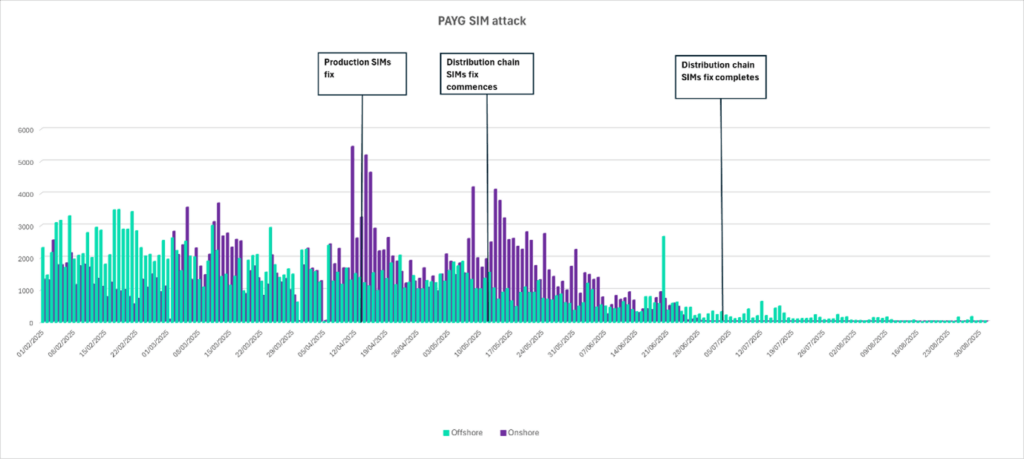
BT data: Graphic from BT fraud monitoring team charts the progress and remediation of the attack where they identified their PAYG SIMs were being used from both UK and offshore jurisdictions to create rogue social media accounts. Having identified the attack, where SIMs were being activated onshore and offshore BT put in place a two-part fix. First part was to ensure that no further SIMs were manufactured and distributed in such a way that they could receive a text message before first top up. With this in place BT were able to tackle the SIMs already in the distribution chain, several millions, and raise the financial bar for BT SIMs being abused. Simultaneously we recognised the opportunity to provide share intelligence with Stop Scams UK members enable the identification and take down of rogue identities. See shows the fraud attack tailed off quickly once actionable data sharing was implemented.
Learn more about the Blocked SIMs programme.